

Smart Home for Seniors Virginia: Preventing Falls With Automation

A smart home setup for seniors in Virginia helps prevent falls by lighting dark paths before someone walks down them. In older Arlington, VA, homes, we start with automated pathway lights and hardwired voice alerts rather than relying on battery connections.
The wiring comes first if old plaster walls hide damaged low-voltage cables or the breaker box has no room for dedicated automation circuits.
Older homes here often have two-wire thermostat setups and outdated doorbell transformers. Failed equipment can leave an aging parent without hands-free control just when they need it. At NovaProHome, we fix those electrical gaps so the automation responds without delays or dropped connections.
What's Inside This Guide
- The Hidden Fall Risks Lurking in Older Arlington Hallways
- Hardwired Power Versus Battery Hardware for Reliable Fall Prevention
- Selecting Automation Hardware Based on Senior Mobility Profiles
- Unifying Google Nest Devices for Whole-House Illumination and Voice Control
- Professional Wiring Steps That Guarantee Continuous System Operation
- Allocating Hardware and Labor Budgets for Senior Living Spaces
- Straight Answers on Senior Automation in Arlington
- Planning an Assisted Living Automation System in Arlington
The Hidden Fall Risks Lurking in Older Arlington Hallways
A trip can start with something as ordinary as checking a noise at the door or turning up the heat. Hurrying through a dark hallway to find a wall switch puts an older resident at greater risk of falling.
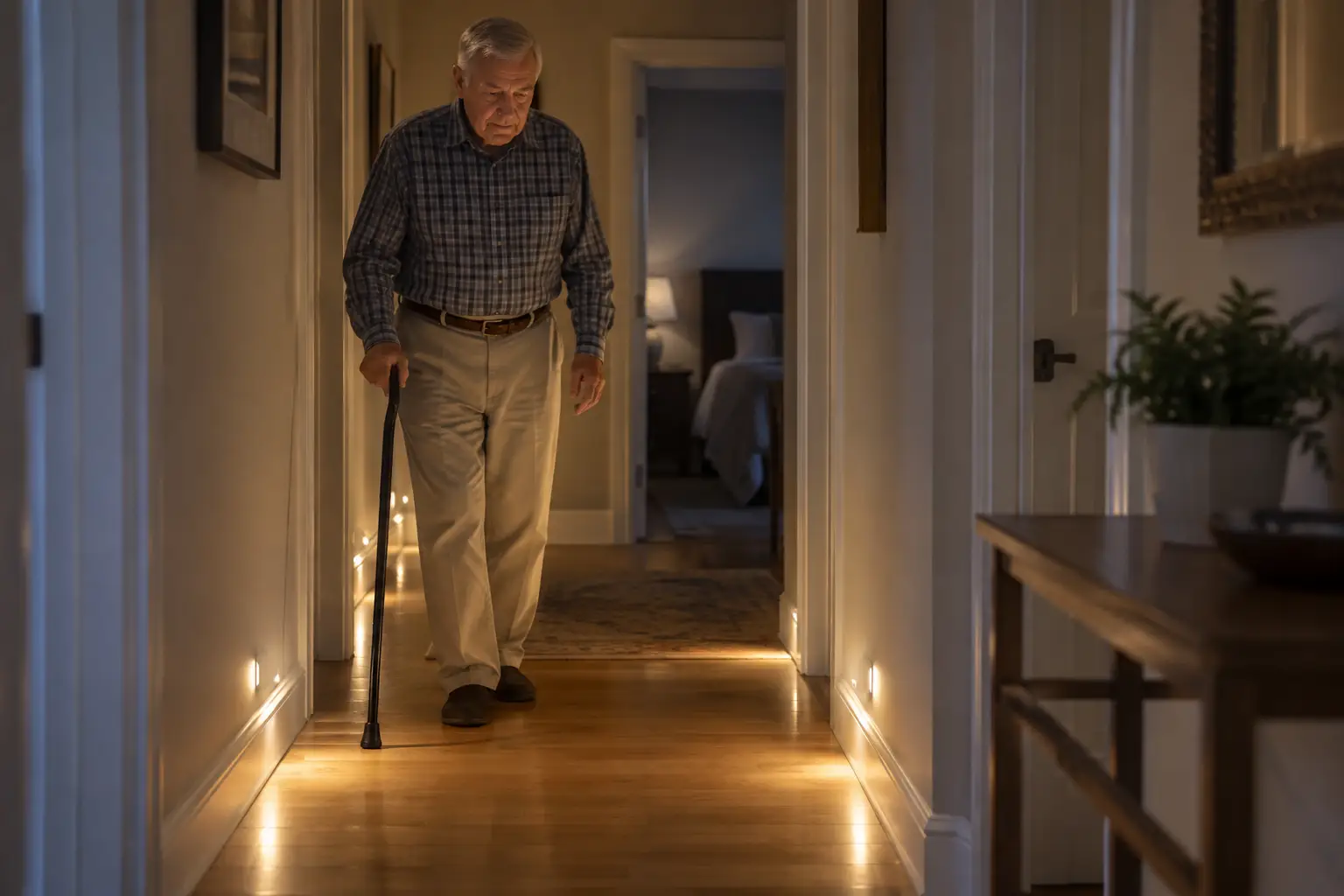
According to the Centers for Disease Control and Prevention, falls are the leading cause of injury among older adults. Familiar paths inside the home can still be dangerous when the lighting is poor.
Poor installation adds to that risk. Battery-powered cameras in a DIY setup eventually stop streaming if nobody charges them. An aging parent may then get up to peer through a dark window instead of checking a mounted display, taking a trip they could have avoided.
Mismatched equipment can also go offline when the supply voltage is too low. Motion sensors cannot trigger smart bulbs through a disconnected hub, leaving the hallway dark. Our guide to seven smart home features for aging in place in Northern Virginia explains why steady power matters more than the number of gadgets installed.
Installer's rule: Never make battery sensors the only safeguard on a nighttime route where a missed detection leaves someone in darkness.
Hardwired Power Versus Battery Hardware for Reliable Fall Prevention
Battery devices are easy to place around a multi-level Arlington home, but someone has to keep them charged. Climbing a step stool to replace a camera battery creates the very fall risk you want to remove. Hardwired low-voltage power keeps sensors supplied without those battery changes and supports continuous communication between devices.
Core Power Infrastructure Options
Checking the electrical system early helps prevent equipment from cutting out during a nighttime bathroom trip. Before buying hardware for a home with frayed wiring, arrange a home assessment. We can inspect the low-voltage lines inside the walls and identify what needs attention.
| Option | Recommended Starting Point | What to Watch |
|---|---|---|
| Hardwired low-voltage power | A dedicated 24V transformer supplying hubs, cameras and pathway lights | Brittle insulation on old doorbell wires that can cause shorts behind lath walls |
| Line-voltage smart controls | Hardwired switches and dimmers connected directly to the lighting circuits | Shallow metal switch boxes without neutral wires behind the wall plate |
| Rechargeable wireless devices | Temporary use on bedside tables or counters that are easy to reach | Battery drain in cold drafts that leaves sensors offline without warning |
Compare the options with our smart home security maintenance checklist before settling on equipment. Stable voltage protects the electronics and keeps them working for the person who depends on them. Battery upkeep needs to be part of that decision, not an afterthought.
Selecting Automation Hardware Based on Senior Mobility Profiles
Equipment needs to suit the resident's daily habits and movement. Someone who uses a walker needs lights to respond well before they reach a dark stretch of floor. For a resident losing their vision, a soft amber glow at floor level helps them find their way without harsh glare.
| Situation or Style | Recommended Choice | Avoid |
|---|---|---|
| Limited mobility with a walker | Ceiling-mounted motion sensors wired directly to low-level step lights | Controls that make the resident reach across furniture to press a wall button |
| Mild cognitive changes | Scheduled routines with physical switches that remain usable | App-only controls whose changing screens can confuse the resident |
| Severe night blindness | Under-bed light strips that work with low-glare hallway step lights | Overhead white lights suddenly switching to full brightness and obscuring vision |
For door hardware that works with entryway cameras, see our guide to choosing a smart lock for a Northern Virginia family. Connecting locks with outdoor sensors helps residents avoid rushing to answer the doorbell. The controls should support how they already use the entrance.
Practical check: Place path sensors at waist height near the foot of the bed so feet reaching the rug trigger light before the resident stands.
Unifying Google Nest Devices for Whole-House Illumination and Voice Control
Bringing Google Nest devices under one set of controls makes them easier for an older resident to use. A bedside Nest Hub offers voice control for the temperature and a view of the porch without getting up. Doorbell footage appears on the display when someone rings, removing the need to hurry to the entrance.
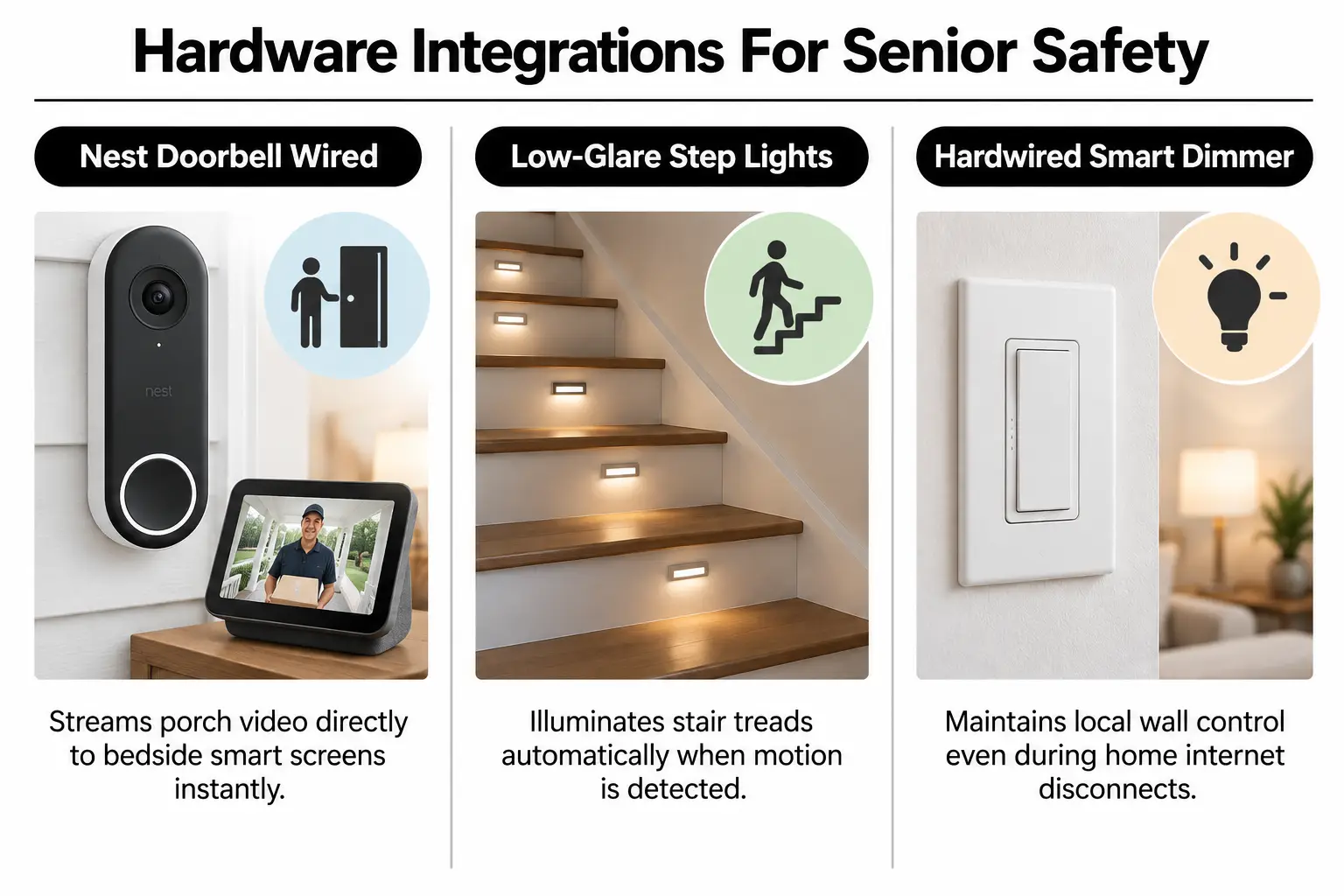
Devices need compatible communication standards to work together properly. Our guide to hubs for Ring, Nest and Lutron explains how lighting controls connect with video equipment. Checking those connections before installation helps avoid network conflicts that leave one part of the setup unresponsive.
| Starting Point | Pairing Direction | What to Sample or Test | Intended Effect |
|---|---|---|---|
| Nest Doorbell (Wired) | Smart pathway dimmers | How quickly a doorbell ring brings the porch lights up | Lights the front steps before the resident greets a visitor |
| Nest Cam (Outdoor Wired) | Indoor display hubs | Delay before video appears over the local 5GHz Wi-Fi connection | Shows who is outside without a hurried move out of a chair |
| Nest Learning Thermostat | Dedicated common (C) wire for continuous power | Whether voltage stays steady while the heating fan runs continuously | Prevents repeated display restarts and unexpected loss of room heat |
Apartment residents can consult our renter's guide to smart home security in Northern Virginia for options that respect lease terms. In a single-family home, permanent copper wiring remains our preferred approach. It supplies the devices without adding another set of batteries to maintain.
Professional Wiring Steps That Guarantee Continuous System Operation
Safety automation still has to meet electrical code. The National Electrical Code (NFPA 70) sets rules for circuit protection, wire size and how much wiring a box can hold. Shortcuts with low-voltage cables can cause equipment failures or leave a fire risk hidden behind wood framing.
Video: Installing and using motion sensor lights for fall prevention in people with lymphedema (JD The OT)
- Check panel capacity: Make sure the home's electrical panel can supply the added low-voltage transformers without overloading existing breakers.
- Run dedicated common wires: Install 18/5 thermostat cable, which has five 18-gauge wires, for a continuous 24V supply without power-stealing lockups.
- Replace entryway transformers: Upgrade original 10VA chime transformers to 16V-24V 30VA units so the cameras have enough power to keep streaming.
- Route camera cables inside walls: Run hardwired connections through wall cavities to avoid camera connection failures caused by thick brick walls.
- Set nighttime lighting routines: Program hardwired dimmers to provide low, gentle light when sensors detect motion along the baseboards after dark.
Before you buy: Check for an available terminal marked C on the furnace control board before choosing a thermostat that does not use batteries.
Use our pre-installation checklist to check network capacity and switch-box depth before removing wall plates. Knowing what is behind the wall helps us plan the cable runs. That preparation keeps damage to the walls as small as possible.
Allocating Hardware and Labor Budgets for Senior Living Spaces
Leave room in the budget for electrical labor as well as devices. Cheap smart bulbs save little if repeated Wi-Fi dropouts leave an older family member in a dark room. Hardwired wall controls keep the physical switches usable when internet service goes down, so the resident still has a familiar way to turn on a light.
| Budget Level | What to Prioritise | What to Question |
|---|---|---|
| Basic ($) | Automatic plug-in nightlights and bedside speakers with voice control | Proprietary smart bulbs that prevent use of ordinary wall switches |
| Intermediate ($$) | A hardwired Nest Thermostat, a higher-output doorbell transformer and hallway motion dimmers | Outdoor battery cameras that require regular ladder work for charging |
| Complete ($$$) | Permanent cable runs, low-glare automatic paths throughout the house and connected displays | Complicated lighting routines that family members struggle to understand |
Paying for wiring installed by licensed electricians addresses the power supply from the start. Hardwired equipment removes the recurring problem of drained batteries. For a senior getting out of bed at night, that means dependable hands-free light as their feet reach the rug.
Straight Answers on Senior Automation in Arlington
smart lighting installation virginia: what is the best way to light dark stairs?
Hardwired low-voltage LED step lights along the baseboard are the best starting point, with motion sensors at both landings. Someone approaching from either floor can trigger the lights without searching for a switch. Keeping the stairs lit this way supports safer trips between floors at night.
smart home for seniors virginia: how does automation prevent common bathroom falls?
Bedside sensors trigger soft floor lighting as soon as an older resident gets out of bed. Gradually lighting the route to the bathroom avoids the sudden glare that can cause confusion and missteps. Voice control also lets them turn lights off without leaning across a wet counter to reach a switch.
home automation near me: can older Arlington brick houses support modern wiring?
Older brick and plaster homes can accept modern wiring with an electrician experienced in routing cables behind historic framing. Carefully planned drill paths and small access cuts protect the walls while making room for needed neutral wires. Those methods allow safety controls to be installed without sacrificing the home's older finishes.
smart lighting installers near me: why do smart switches require a neutral wire?
Smart switches need continuous power for their wireless radios, even while the light is off. A neutral wire provides that path. Without it, switches draw power through the light itself, which can make smart bulbs flicker or disconnect. Dedicated neutral wires give the controls a stable supply throughout the lighting system.
smart home: can Google Nest displays act as visual intercoms for seniors?
Google Nest Hub displays show live footage when someone rings the front doorbell or triggers an outdoor camera. Two-way audio lets a senior speak with visitors while staying seated. Being able to check the entrance from a chair removes the pressure to hurry down a long hallway to answer the door.
home automation repair virginia: why does my smart doorbell keep restarting?
Repeated restarts point to a chime transformer that cannot supply enough power, often located in a basement or hallway closet. Original units commonly supply 10VA, while video doorbells need 16V to 24V at 30VA during ringing and streaming. Replacing the old unit with a suitable modern transformer resolves that shortage.
Planning an Assisted Living Automation System in Arlington
At NovaProHome, we plan the wiring alongside the equipment for an aging relative's home. Skipping that work can leave the family dealing with frequent maintenance and dark spots where lights should respond. Our team checks the power supply and connections for each device rather than treating the gadgets as separate installations.
Our licensed electricians bring extensive systems engineering experience to this work. Dedicated C-wires and replacement doorbell transformers address power problems, while repairs to camera wiring restore failed connections. Before proceeding with an installation, check these items:
- Transformer assessment: Check that the chime transformer supplies at least 30VA.
- Neutral wire check: Look for neutral wires inside the main switch boxes.
- C-wire continuity: Inspect the heating control board for an active 24V common terminal.
- Corridor coverage: Place motion sensors along the routes used at night.
- Display positioning: Secure tabletop displays within easy reach of favorite seats.
For an in-home evaluation of fall-prevention automation in Arlington, VA, contact the NovaProHome team.
Ready to engineer your smart home?
Start with a free 20-minute discovery call. No pressure, no sales script — just a plan.